
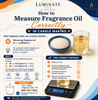
Why You Should Always Measure Fragrance Oil by Weight
, by Mika Jackson, 3 min reading time
, by Mika Jackson, 3 min reading time
When you're first learning to make candles, it's easy to assume that measuring fragrance oil in milliliters (ml) is the right way to go. After all, fragrance oil is a liquid. But one of the biggest lessons every candle maker learns is that fragrance oil should always be measured by weight—not by volume.
Whether you use grams (g) or ounces (oz), measuring by weight gives you more accurate and consistent results.
Making this one change can improve your candle's scent throw, burn performance, and overall quality.
The Problem with Measuring in Milliliters
Not all fragrance oils weigh the same.
Each fragrance contains a unique blend of ingredients, and those ingredients affect the oil's density. That means two different fragrance oils can have the same volume but completely different weights.
For example:
If you're measuring by volume, you're actually adding different amounts of fragrance every time you switch scents.
The result? Your candles may perform differently even though you followed the same recipe.
Why Weight Is Important
Professional candle makers formulate recipes based on weight because wax is also measured by weight.
Using a digital scale allows you to:
Consistency is one of the biggest differences between hobby candle making and producing candles customers can rely on.
Grams vs. Ounces: Understanding the Important Difference
Many candle makers in the United States use either grams (g) or ounces (oz). Both are perfectly acceptable because they measure weight.
The confusion comes from fluid ounces (fl oz), which measure volume, not weight.
Here's a quick breakdown:
Grams (g) = Weight
Ounces (oz) = Weight
Milliliters (ml) = Volume
Fluid Ounces (fl oz) = Volume
It doesn’t matter which unit you choose, the goal is the same: measure your fragrance oil by weight using a digital scale.
The Correct Way to Measure Fragrance Oil
Follow these simple steps:
1. Weigh your wax.
2. Decide on your fragrance load based on your wax manufacturer's recommendations.
3. Calculate the amount of fragrance oil needed.
4. Measure the fragrance oil using a digital scale.
5. Add the fragrance oil to your melted wax at the recommended temperature.
That's it.
Example Calculation
Let's say you're making a candle with:
Wax Weight: 500 grams (17.64 oz)
Fragrance Load: 8%
The calculation looks like this:
500 g × 8% = 40 g of fragrance oil
17.64 oz × 8% = 1.41 oz of fragrance oil
Notice that you're measuring 40 grams or 1.41 ounces by weight—not 40 ml or 1.41 fluid ounces.
Using a digital scale ensures your fragrance load is accurate and your candle performs as intended.
A Few Extra Tips
My Approach
I believe great candles begin with great processes. Every candle starts with accurate measurements, quality ingredients, and attention to detail. Measuring fragrance oil by weight isn't just a best practice, it's one of the foundations of creating candles with reliable scent throw, clean burns, and consistent quality.
The basics will save you time, reduce waste, and help you create candles you're proud to share.
Your digital scale is one of the most important tools in your candle-making workspace. Measure your fragrance oil by weight using grams or ounces, not milliliters or fluid ounces, and you'll be one step closer to making professional-quality candles every time.